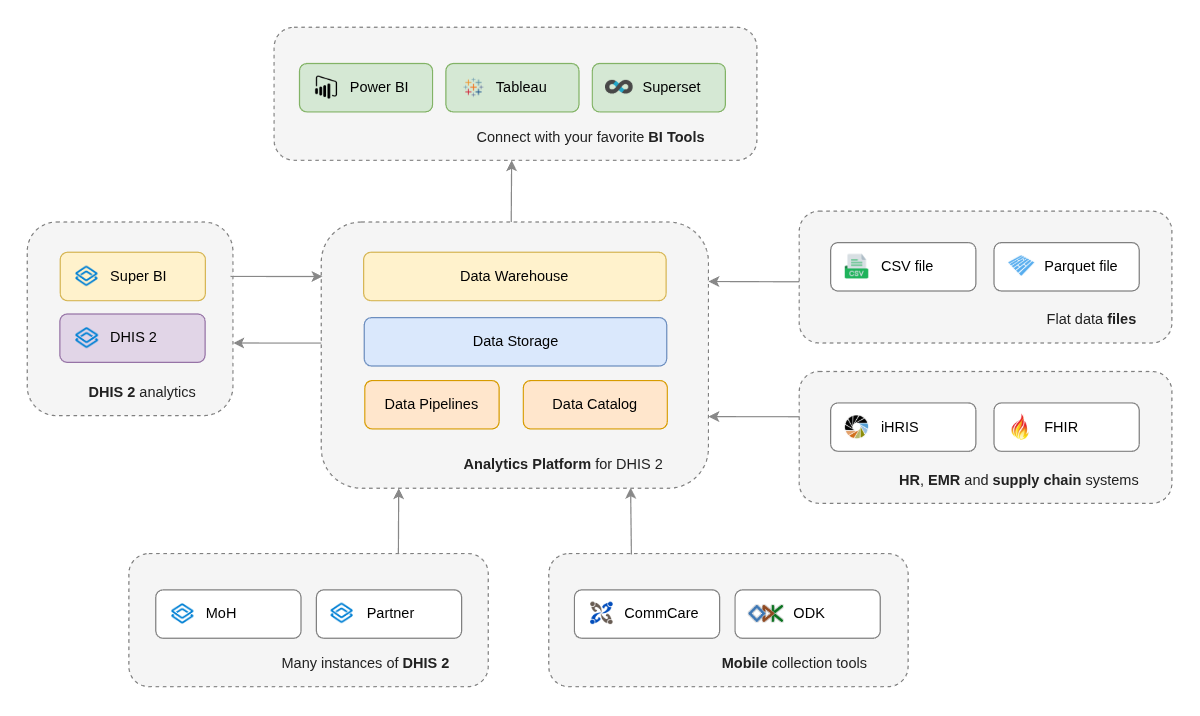
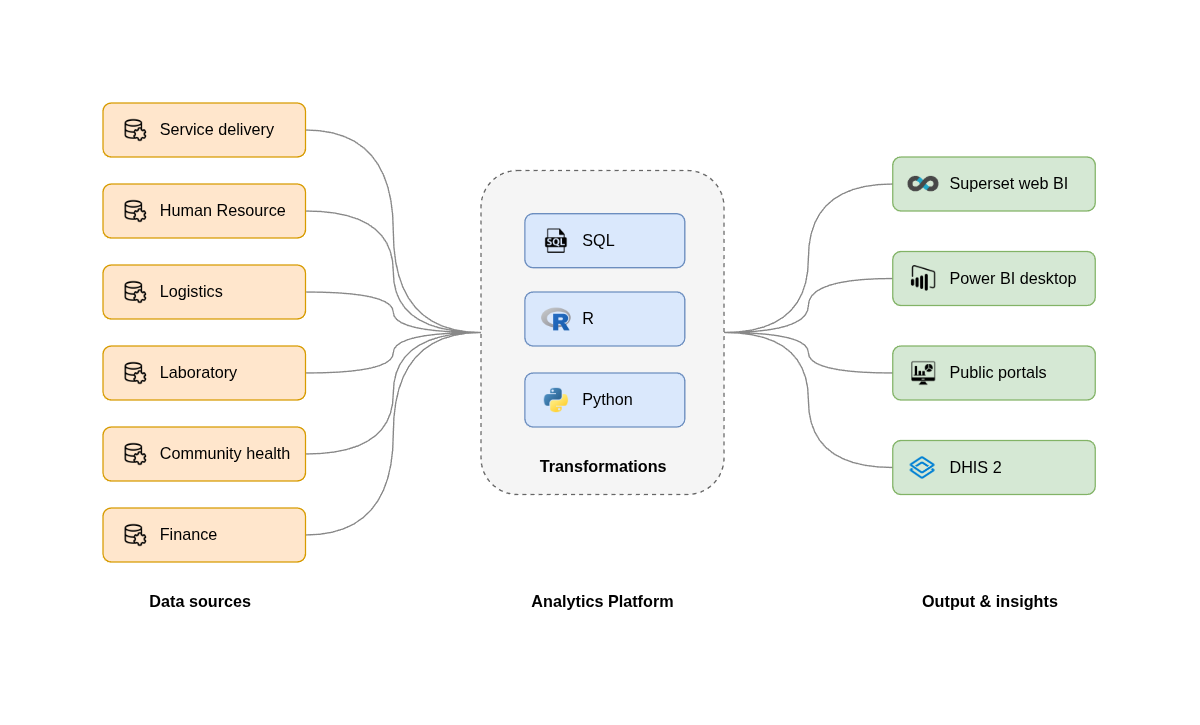
Data ingest and integration: The platform provides no-code connectors to systems, databases and tools commonly used in the international development sector, allowing for near real-time data loading.
Data transformation: Data can be transformed and enriched using SQL views, Python scripts and R scripts upon ingestion. Furthermore, data sets can be parsed and joined to create unique data views for enhanched analysis.
Natural text queries: Users can ask data questions in natural text and have AP convert to SQL queries for informational retrieval, allowing non-technical users to ask complex questions and analyze and retrieve data.
R and Python: Users can develop R and Python scripts with the web-based, integrated scripting editor and execution compute, allowing for statistical calculations, data modelling, data science and machine learning.
Data warehousing: Data is organized and stored in a scalable cloud-based warehouse. AP integrates with ClickHouse, PostgreSQL, SQL Server, Amazon Redshift, Azure SQL Database and Anzure Synapse.
Import of public data sets: The platform offers easy import of publicly accessible data sets. A range of datasets exist within the library, including from the UN, WHO Global Health Observatory and World Bank.
User management: Users and user groups can be created and managed. AP offers a fine-grained access control and security model, where each access to each individual object can be granted to users and user groups.
Monitoring, logging and alerts: The platform provides monitoring and logging for data pipelines and workflows, and alerts on failures so that issues can be immediately detected and corrected.
Workflow mananagement: Users can orchestrate complex, multi-step data processes with a powerful workflow builder, handling data loading, transformation with SQL, R and Python, pushing data to destination systems.
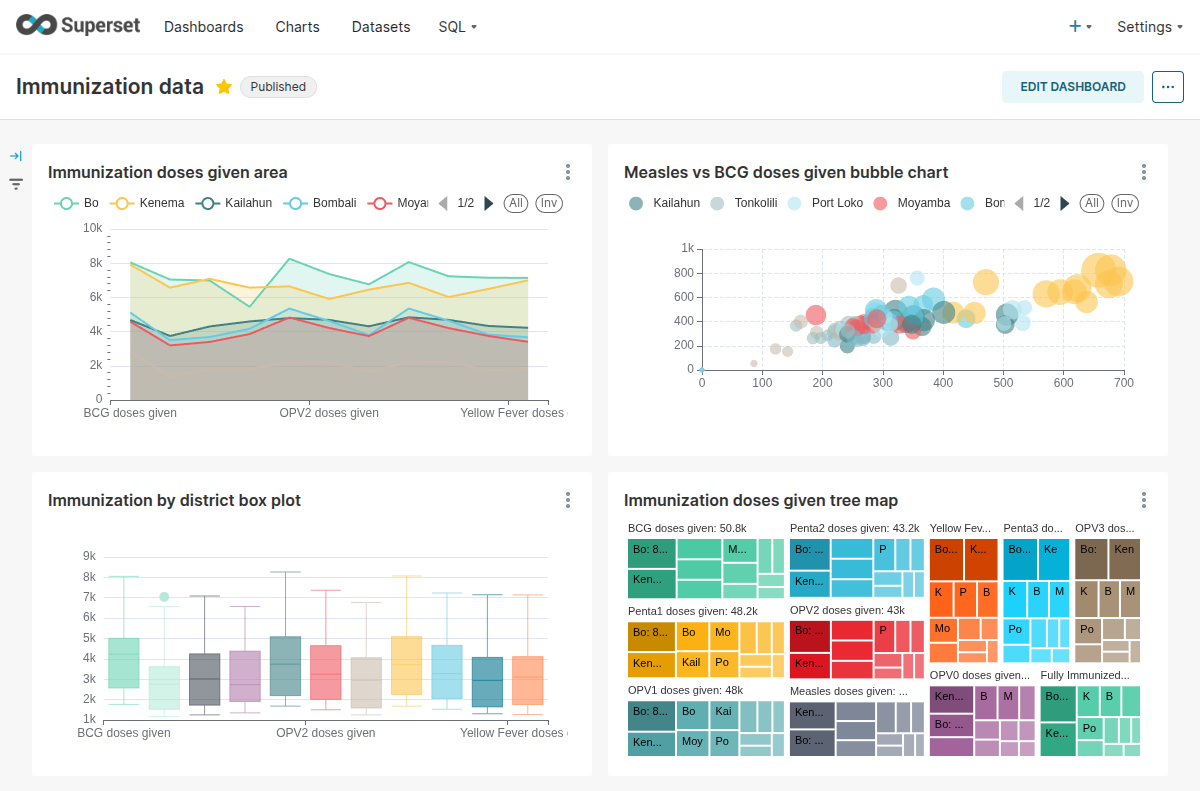
Analytics and BI tool integration: The platform supports most leading analytics and business intelligence tools, including Power BI, Tableau, and Superset, to create customized visualizations and dashboards.
Embedded visualization: Data visualization and dashboards can be embedded in popular systems including DHIS2 using the Super BI web app, allowing visualizations to be consumed with existing user accounts.
Security: Data is encrypted during transit and at rest in the data warehouse. AP offers firewall management for BI tool connections. The managed service from BAO Systems includes web application firewall (WAF) and application scanning.